Automated CNC Machine Tending Robot and Cobot Cells
Ergonomic Partners, a leader in material handling solutions, offers advanced machine tending robots and cobot cells to revolutionize your CNC production process. Our expertise in industrial automation allows us to deliver cutting-edge machine tending automation solutions tailored to your specific needs.
Benefits of Robotic Machine Tending
- 24/7 Production Boost: Increase productivity by keeping your CNC machines operating continuously with robotic assistance.
- Reduced Labor Costs: Automate repetitive processes to achieve substantial savings on labor expenses.
- Precision & Consistency: Ensure high-quality, uniform parts through the precise actions of robots.
- Enhanced Safety: Reduce risks to operators by assigning robots to handle heavy or dangerous materials.
- Optimized Workflow: Allow your workforce to focus on more valuable tasks and make your CNC operations more efficient.
Machine tending refers to the automated loading and unloading of parts from CNC machines using robotic systems. Our comprehensive automation cnc machines and robotics solutions include both collaborative robots (cobots) for flexible human-robot collaboration and industrial robots for high-volume automated machine tending systems that integrate seamlessly with existing manufacturing cells.
With over 65 years in the material handling industry, Ergonomic Partners understands the ins and outs of CNC machine operation. We've seen firsthand the challenges manufacturers face in optimizing CNC workflows. These challenges include maximizing uptime, minimizing operator fatigue with repetitive tasks, and ensuring safety around potentially heavy or hazardous materials. This in-depth understanding positions us uniquely to deliver custom machine tending solutions that provide rapid return on investment through increased production capacity, reduced labor costs, and improved quality. Whether a fully autonomous machine tending robot or a collaborative robot cell, our automated machine tending robots are designed to address these specific pain points, streamlining your material handling process and optimizing your CNC operation for maximum efficiency.
Automated Machine Tending in Action
Robot Machine Tending for Steel Blanks
Our Ergonomic Partners robotics team helped our customer gain a competitive edge in the marketplace and streamline their production operations, with this robotic machine tending process that improved efficiency, safety, quality, and productivity. The customer loads blanks onto a table and a magnetic separator is used to separate the parts. The robot picks up the part and puts it into a squaring station to ensure the proper orientation. Next the robot loads the part into the press. The part is then bent to shape, picked up, and palletized.
Machine Tending Robot for Multiple CNC Processes
This robot cell was designed to take a raw casting and load it through three processes. It initially runs through two lathe functions and then runs through the final vertical milling stage. After it has gone through this process, a Marposs gauging system will check to ensure that the part is within tolerance before placing it on the outgoing pallet. This system allowed the customer to run two shifts unmanned per day, creating a lights-out facility operation that significantly increased production capacity while maintaining high quality standards and reducing operational costs.
Automated Press Tending Robot
Ergonomic Partners was tasked with coming up with a solution to handle incoming sheet metal cut on a plasma table. The process required 5 different brake functions. The robot coordinated its movement with the pinch function on the press. Hence, the robot was able to let go of the part once it was given the signal the part was supported. There was a rack designed to load up to 10 parts, allowing them to run this part for several hours without an operator.
CNC Machine Tending Robot
This system was designed to take raw blanks and run them through a complete CNC process. The incoming cart was designed by EP to allow for long run times between reloading. The system included a Marposs gauge to ensure the parts were within tolerance after machining. This freed up the operator in the area to do another task while the machine ran during the shift.
Machine Tending for 3-Step Punch Press
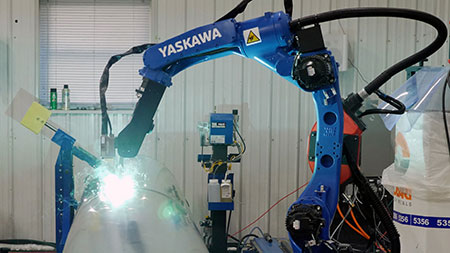
Ergonomic Partners was asked to design a system that would allow for an 8-hour run time without an operator. The first step was to design an income rack that could be consistently located with enough parts to accommodate that run time. The Yaskawa robot was on a portable base and had on board area scanners to allow for this unit to be moved to multiple machines. The robot would pick up the initial part and take it through three punch processes to get the desired result. The part was then loaded on an outgoing rack designed by Ergonomic Partners for a complete turnkey solution.
Robot and Automation Videos
Want to see more examples of industrial robots in the work place? Head over to our Robot and Automation Videos to see other solutions we have developed for our customers!
Automated CNC Machine Tending Robots
CNC (Computer Numerical Control) machines are widely used in manufacturing processes to automate tasks such as cutting, drilling, and shaping materials. Traditionally, these machines require human operators to load and unload materials, which can be time-consuming and prone to errors. However, with the introduction of robotic machine tending and manufacturing cell automation, manufacturers can now streamline their cnc work cells and achieve higher levels of efficiency.
Machine Tending Robot Applications
- Machine Loading and Unloading: Our machine tending robots optimize CNC operations by automating part loading and unloading. These automated machine tending systems include both collaborative robots (cobots) for flexible operations and industrial robots for high-volume production, boosting throughput while reducing labor costs and ensuring consistent part quality.
- Part Sorting and Stacking: Streamline your post-machining process with our robotic part sorting and stacking solutions. Our cobot machine tending options provide safe human-robot collaboration while automated systems enhance efficiency by eliminating manual handling delays, freeing up labor for value-added tasks and improving overall production flow.
- Tooling and Changeover: Minimize downtime and maximize machine utilization with our automated tooling and changeover systems. Our CNC automation robots handle tool changes swiftly and accurately, increasing productivity by eliminating human error during setup operations.
- Inventory Management: Integrate our machine tending robots with your inventory system for seamless and efficient material flow. These collaborative robots for machine tending can work alongside operators to optimize stock levels and reduce lead times through just-in-time component delivery.
Industries Benefiting from Machine Tending Robots
- Automotive: Boost automotive production by eliminating downtime and improving part quality when manufacturing engine blocks, transmissions, and body panels using both collaborative robots and industrial automation systems. Our automotive clients achieve substantially higher machine utilization and excellent first-pass quality rates, creating a direct competitive advantage.
- Aerospace: Ensure the highest levels of accuracy and precision needed for aircraft components, turbine blades, and fasteners. Our aerospace clients report excellent precision rates and minimal scrap from automated processes.
- Machining and Fabrication: Enhance production efficiency and versatility to optimize the manufacturing process for items such as metal and plastic parts to custom fabrication. Typical clients see substantial production increases with the same floor space and equipment.
- Electronics: Precise and rapid machine tending accelerates manufacturing of electronic devices such as printed circuit boards, semiconductors, and electronic enclosures. Our cobot machine tending solutions provide the flexibility needed for varied production runs while electronics manufacturers achieve notable cycle time reductions.
- Medical Devices: Maintain sterile conditions and high-quality standards while manufacturing medical devices such as implants, surgical instruments, and orthopedic devices. Our medical device clients report significant contamination reduction and excellent traceability of all components.
Custom Gauging for CNC Machine Tending
When using robotics for automated machine tending applications and cnc work cells, including both collaborative robots and industrial automation systems, it is often helpful and in many cases necessary to add in-process or post-process measuring capabilities to your automated system. Ergonomic Partners integrates precision gauging solutions to ensure parts remain in tolerance and provide real-time feedback to machines for adjustments as needed.
Our Gauging Capabilities:
- In-Process Measurement: Monitor part quality during the machining process to catch deviations immediately.
- Post-Process Verification: Verify final part dimensions and tolerances before parts move to the next operation.
- Machine Feedback Systems: Provide real-time data to CNC machines to automatically adjust for part deviations and tool wear.
- Contact and Non-Contact Technologies: Select the optimal measurement method based on your specific application requirements.
Equipment We Use:
Our team utilizes industry-leading measurement equipment from Marposs and Keyence to perform a comprehensive range of measurement tasks. Whether your application requires contact probes for precise dimensional verification or non-contact laser/vision systems for delicate or complex geometries, we select the right technology for your specific needs.
Benefits of Custom Gauging:
- Prevent Bad Runs: Stop production before making entire batches of out-of-tolerance parts.
- Tool Life Optimization: Get clear data on cutting tool performance and lifespan.
- Continuous Quality Control: Maintain consistent part quality even during lights-out warehouse operations.
- Process Improvement: Use measurement data to optimize machining parameters and reduce scrap.
Ready to Transform Your CNC Operations?
Take the next step toward lights-out manufacturing with Ergonomic Partners' automated machine tending solutions. Our experienced team will work with you to design, build, and implement a custom robotic system that maximizes your productivity and ROI.
Get Started Today:
- Free Consultation: Discuss your specific machine tending challenges with our automation experts.
- Facility Assessment: We'll evaluate your current operations and identify automation opportunities.
- Custom Solution Design: Receive a tailored proposal for your CNC machine tending automation.
Contact us today to schedule your consultation and discover how automated machine tending can revolutionize your manufacturing operations.
Frequently Asked Questions
What machines can a robot or cobot tend?
CNC lathes, vertical machining centers, mills, press brakes, punch presses, and injection molding presses are all common machine tending applications for both robots and cobots. The robot's end effector — the gripper or tooling mounted at the end of the arm — is custom-designed for the specific part geometry and machine interface, so the tending system is not limited to a single machine type. If your facility runs multiple machine types, a portable robot base (as used in EP's 3-step punch press cell) allows a single robot to be repositioned between machines as production needs change.
How does a machine tending robot load and unload parts?
A machine tending robot uses a custom end effector to pick a raw part from an incoming rack or staging area, orient it using a squaring station or vision system, load it into the machine fixture, and retrieve the finished part when the cycle completes. In EP's steel blank machine tending cell, a magnetic separator first isolates individual blanks before the robot picks and squares each part, ensuring consistent fixture registration on every cycle. The end effector design — grip force, jaw geometry, and material contact points — is determined by part weight, shape, and surface condition, and is engineered for each application.
Can a single robot tend multiple machines at once?
A single robot can tend two or more machines in sequence when cycle times allow the robot to transfer between machines without creating a bottleneck — a configuration called multi-machine tending or cell tending. In EP's multi-process CNC cell, one robot handles two lathe operations and a vertical milling stage on a single casting before placing it on the outgoing pallet. Whether a single robot can tend multiple machines depends on the per-machine cycle time, travel distance between machines, and part handling complexity; EP engineers the cell layout to ensure the robot's transfer time fits within the machine cycle.
What is lights-out manufacturing and how does machine tending enable it?
Lights-out manufacturing is production that runs for an extended period — typically a full shift or overnight — without a human operator present, and machine tending robots are the primary enabler for CNC operations. EP's multi-process CNC cell ran multiple unmanned shifts per day; the punch press tending cell was designed specifically for extended unattended operation using a Yaskawa robot on a portable base with on-board area scanners. The key requirements for lights-out capability are a sufficiently large incoming part supply (custom incoming racks or carts sized for the target run time), integrated gauging to catch out-of-tolerance parts before they accumulate, and area scanning for safe unattended operation.
What happens when a part falls outside tolerance during automated machine tending?
When integrated gauging detects an out-of-tolerance part, the robot cell stops production before additional bad parts are made — preventing a bad run from compounding into a full batch of scrap. EP integrates Marposs contact gauging and Keyence non-contact laser and vision systems for post-process verification; in EP's CNC multi-process cell, the Marposs gauge checks each casting after the milling stage before the robot places it on the outgoing pallet. The machine feedback loop goes further: real-time dimensional data can be fed back to the CNC controller to automatically compensate for tool wear, extending tool life and maintaining tolerance without manual intervention.
What's the difference between using a robot versus a cobot for machine tending?
An industrial robot runs at full speed inside a guarded cell with no operator access during operation, making it the right choice for high-volume, high-speed machine tending where throughput and cycle time are the primary constraints. A collaborative robot (cobot) operates at reduced speed and force limits that allow it to work alongside operators without full perimeter guarding, making it the better fit for lower-volume or mixed-part production where an operator needs to intervene, adjust fixtures, or handle changeovers at the same workstation. EP designs and integrates both configurations as part of our industrial robotic automation services; the selection depends on your cycle time targets, required throughput, floor space, and how frequently an operator needs access to the machine during production.
Ergonomic Partners designs, builds, and programs Automated CNC Machine Tending Robots and Collaborative Robots; serving clients from coast to coast, Canada, and Mexico, and especially focused in the states of Missouri, Illinois, Indiana, Kansas, Arkansas, Florida, Georgia, South Carolina, North Carolina, Tennessee, Nebraska, Kentucky, Iowa, Wisconsin, Oklahoma, Pennsylvania, South Dakota, Ohio, Alabama, Mississippi, Minnesota, Virginia, West Virginia, Louisiana, and Maryland.