Portable Cobot Welding Packages
In the manufacturing and construction industries, welding plays a crucial role in joining metal parts together. But traditional welding methods can be time-consuming, labor-intensive, and limited in their capabilities. And when you add to that the ongoing shortage of skilled welders, you can understand why the welding industry has been experiencing significant delays in work and disruptions in the supply chain. One solution that has gained popularity among professionals to combat the skilled labor shortage and keep up with welding demands is the use of collaborative robot welding.
A cobot, or collaborative robot, is an industrial robot that operates alongside human workers to improve production and workplace safety. They can be programmed to perform tedious, repetitive tasks while the skilled worker performs more specialized tasks. So in the welding industry, a collaborative welding robot can be programmed to weld some of the seams and joints, while the experienced welder focuses on the more complex welds.
Ergonomic Partners offers industrial-hardened, portable welding cobot packages featuring Yaskawa/Motoman cobots and Fronius welders. These portable weld systems are designed to be taken anywhere in your facility, allowing welding operations to be performed quickly and effortlessly. So whether you need to weld in tight spaces or move the welding operation to different locations, our portable cobot welding solutions can revolutionize your workflow.
Long Reach Portable Weld Cobot
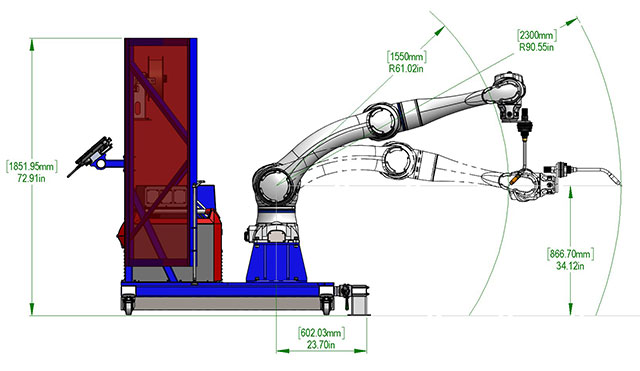
Our portable weld cobots come in two packages, the HC10 and HC20. The HC20 is the longest-reach cobot on the market with 2,300 mm (90.55 inches) of reach, 20 kg (44 pound) payload capacity, and +/- 0.05 mm repeatability. This makes it ideal for setting up multiple parts or larger assemblies.
The more affordable HC10 has 1,200 mm (47.24 inches) of reach, 10 kg (22 pound) payload capacity, and +/- 0.05 mm repeatability. This package is designed and optimized for smaller parts and assemblies.
Features Include:
- Forklift pockets.
- Foldable weld curtains.
- Easy to roll casters.
- Easy to program with fast teaching times, even for those with no former knowledge of robot programming.
- Easy for welders to set up the welding parameters without requiring a human welder for daily welding operations.
Fronius Cobot Standard Weld Package
- TPS 400i Gas Cooled Push System
- 0.045 Filler Materials
- Wire feeder mounted on the frame of the unit
Optional Fronius Weld Packages
- Pulse Multi Control (PMC) allows you to achieve better results during pulse welding. It imparts less heat and reduces spattering.
- Low Spatter Control (LSC) is a process designed with a modified dip transfer arc with high stability. The welder can achieve high quality weld seams while minimizing spattering and increasing deposition rate.
- Cold Metal Transfer (CMT) uses extremely low heat input for joining materials like steel and aluminum. It is capable of brazing galvanized metal sheets with minimal distortion.
- Push/Pull Systems for aluminum welding.
- Liquid Cooled Welding System in lieu of gas-cooled welding systems for high-production applications.
- Manual Welding Torch allows quick changing of the robotic to manual welding operation with the flick of a switch.
Cobot Welding Options
Depending on your welding operation needs, we have several standard options to help you optimize your welding production. We also have 15 engineers on staff, allowing us to easily design customized fixturing according to your welding requirements to help take the guesswork out of your small batch production of welded components.
- Customized Risers - Allows for more reach when working at a higher elevation.
- Docking Stations - Can be installed at different locations within your facility, allowing the portable robot to be moved and locked in place at different welding cells for consistent welding processes.
- Different Size Modular Welding Tables - Tables can be manufactured to easily fix parts in place for quick and easy welding.
Portable Long Reach Welding Cobot
Touch Sense Demo with Yaskawa Robot
Frequently Asked Questions
What makes a cobot welding system portable?
A portable cobot welding system is built on a wheeled, self-contained cart — typically equipped with forklift pockets, easy-roll casters, and foldable weld curtains — so the entire welding cell relocates to where the work is rather than the parts traveling to a fixed station. The Yaskawa HC20 package, for example, integrates the cobot arm, Fronius welder, wire feeder, and modular fixturing onto a single frame that can be moved by forklift or rolled by hand between production areas. Docking stations installed at multiple locations in the facility allow the unit to lock in place and resume welding at consistent, pre-programmed positions without re-teaching the robot.
What's the difference between a portable cobot welder and a fixed robotic welding cell?
A fixed robotic welding cell is a permanent installation — typically enclosed, bolted down, and dedicated to one production line — while a portable cobot welding system is designed to serve multiple weld locations in the same facility from a single unit. Fixed cells require substantial floor space, structural integration, and extended changeover time when product mix changes; a portable cobot can be quickly repositioned and retaught using simple hand-guided programming without specialized robotics training. For facilities with multiple weld points, varying batch sizes, or space constraints, a portable system offers greater utilization per unit of capital invested.
What welding processes can a cobot perform?
The Fronius-equipped cobot packages offered by Ergonomic Partners support Pulse Multi Control (PMC), Low Spatter Control (LSC), Cold Metal Transfer (CMT), and push/pull aluminum welding, in addition to the standard gas-cooled push system included with every package. PMC reduces heat input and spatter during pulse welding; CMT uses extremely low heat for joining steel and aluminum and can braze galvanized sheet with minimal distortion; LSC produces high-quality weld seams with increased deposition rate. A manual welding torch option allows the operator to switch from robotic to manual welding operation with the flick of a switch, without requiring a separate weld source.
How long does it take to set up a portable cobot for a new part?
Setup time for a new part depends on fixturing complexity, but the Yaskawa HC-series cobots are designed for fast teaching — the arm can be hand-guided through weld paths by a welder with no prior robot programming experience, eliminating the need for offline programming software or a dedicated robotics technician. Modular weld fixture tables (available in a range of standard and custom sizes) allow welders to locate parts repeatably from the first cycle. For facilities welding small batch runs of similar parts, the combination of touch-sense capability — which detects part position automatically — and modular fixturing reduces first-part qualification time compared to traditional robot programming workflows.
What size operation is a portable cobot welding system suited for?
A portable cobot welding system is suited for small-to-mid-size manufacturing operations running batch quantities where a full fixed robotic cell is not cost-justified, as well as larger facilities that need flexible welding capacity at multiple locations without investing in multiple permanent cells. The HC10 package is optimized for smaller parts and assemblies; the HC20 handles larger assemblies and multi-part setups. Both packages address the skilled welder shortage directly — the cobot handles repetitive seams and joints while the skilled welder focuses on complex welds that require judgment and adaptability.
Does a portable cobot welding system require safety fencing?
The Yaskawa HC-series cobots are classified as collaborative robots under ISO/TS 15066, meaning they are designed to operate safely alongside human workers without a hard safety fence when deployed within their rated collaborative operating parameters. Unlike traditional industrial robots — which require full perimeter guarding and interlocked access points — cobots use force-limiting and speed-limiting technology to stop or slow on contact with a person. The portable packages from Ergonomic Partners include foldable weld curtains to contain weld flash and spatter; specific guarding requirements depend on the application, payload, and operating speed, and Ergonomic Partners' on-staff engineers perform risk assessments to confirm the appropriate safety configuration for each installation.
Robot Welding Documents and Information
Ergonomic Partners is a robot system integrator that provides portable cobot welding packages and robotic welding solutions nationwide. We have representatives that specifically serve Missouri, Illinois, Indiana, Kansas, Arkansas, Florida, Georgia, South Carolina, North Carolina, Tennessee, Nebraska, Kentucky, Iowa, and Oklahoma.